Showing posts with label end of life. Show all posts

Nimkee Angel Day in SickKids NICU

It is becoming more common to see families posting photos at the end of their child's life and yet each time I see such pictures I am thankful for the parents amazing sharing. My Baby Is An Angel is a blog by a mom of six children honoring one child still born and later named Noah-Alexander (along with her guilt about the silence accompanying this birth) and Bennett-Chadlen "Nimkee" born with Trisomy 13 who died at one week. The website includes links to resources and other family sites and Melissa later wrote a letter wishing parents and staff were more aware that Trisomy 13 is not always a condition 'incompatible with life'. Family photos on Picasa include a poignant transition from mom's pregnancy to grief and death in the NICU and a beautiful set of photos by a photographer with Now I Lay Me Down To Sleep of Nimkee's death in SickKids NICU. Bennet died surrounded by his family's love and tears and father Chandlen playing a song composed for his son. You can hear the song accompanied by the pictures below. Thanks to Melissa and Chandlen for sharing these moving and unforgettable images of Bennet's life.


Under a video of Bennet, his mom writes:

~Breaking the silence of the taboo subject of Infant Loss~


~The background music was written and recorded by Bennett-Chadlen's father, Chadlen. He wrote the guitar portion while he was in the NICU, and this is what our sweet boy heard as he drifted away in our arms.....this montage captures our final moments together. Viewer discretion is advised. I realize that many of you may not understand why a family might want these photos, but they're all we have to hold onto.


~I share this with you.....it's your choice whether you view it or not. Upon viewing, you will understand what we went through....please show compassion to any grieving mothers that you know. Even if you don't have words, a tender touch is enough.

~I'm here to break the silence....so many like me don't have to feel so alone.

~We will never forget, and we want you to always remember.


Nimkee's Facebook page has 169 members!

Where I was in your final hours

You whimpered when we touched you, so I drew back. It was hard to hear that whimper as anything but discomfort, hard to imagine it was a choked purr. You were not calling us and we were so tired and we took a little respite. You were deeply sedated. And I was building your website. Because I loved you and wanted others to see you. Because I didn't know what else to do. Because I didn't want to look at your beautiful face swollen and yellow, your belly so distended, your failing organs congealing so that blood no longer flowed as it had the last week. Your granny and grampy and bubby spent time with you. We dropped in. So much preparation went into bringing you home but a year and a half later I still think about those last hours and ask what else could I have done beside upload pictures and write your story. That was OK, but not for most of your last day. You died as we sang you a song, as if you had waited and I am grateful I held you when you let out your final breath.

How does the palliative care community approach family preparations for their children and siblings final hours? At the beginning we were taken through all the signposts marking the end of life. Afterward we dressed her and I carried Sasha to the mortuary vehicle. Everything was, it seemed, as respectful and dignified and family-centred as could be under the circumstances. And when I look at a support network sheet on the final end of life information or a sensitive and detailed parent account of living with very sick children there is no mention of what parents do during the death of their child. When the breathing becomes very laboured and a nurse or doctor comes to increase the sedatives, that is a good time, if not before, to touch the parents with the moment if they are lost in grief. So they are there. Not on the computer.

Death's opposite

I had carried Mia from the bath to our bed and she was scrambling over the duvet and pillows, propelling herself up the piles of pillows and reaching up the headboard when Mom came up: "I was watching videos of Sasha in the last weeks and she looked so sad. She looked confused; she was not happy." Through my tears, Sasha's little sister purposefully and happily stroked Cat and purred herself.

25 years today, a small plane crashed in the Andes. After two months, two of the survivors set out on a final effort to get help. Walking in jeans and sneakers, one of the party recalled the moment he crested a 17,000 foot peak, expecting to see lush green valleys and instead saw ice and snow as far as the horizon:
"I don't know how long I stood there, staring. A minute. Maybe two. I stood motionless until I felt a burning pressure in my lungs, and realized I had forgotten to breathe. I cursed God and raged at the mountains. The truth was before me: For all my striving, all my hopes, all my whispered promises to myself and my father, it would end like this. We would all die in these mountains. We would sink beneath the snow, and ancient silence would fall over us, and our loved ones would never know how hard we had struggled to return to them. In that moment, all my dreams, assumptions and expectations of life evaporated into the thin Andean air. My love for my father swelled in my heart and I realized that, despite the hopelessness of my situation, the memory of him filled me with joy. It staggered me. The mountains, for all their power, were not stronger than my attachment to my father. They could not crush my ability to love. I felt a moment of calmness and clarity, and in that clarity of mind I discovered a simple, astounding secret: Death has an opposite, but the opposite is not mere living. It is not courage or faith or human will. The opposite of death is love. How had I missed that? How does anyone miss that? Only love can turn mere life into a miracle and draw precious meaning from suffering and fear. For a brief, magical moment, all my fears lifted and I knew that I would not let death control me. I would walk through the godforsaken country that separated me from my home with love and hope in my heart. I would walk until I had walked all the life out of me, and when I fell, I would die that much closer to my father."

"Thoughts About the True Miracle in the Andes", Cynthia Boaz, t r u t h o u t, quoting Nando Parrado from "Miracle in the Andes", 2006

I let Parrado's words hang around a bit. The opposite of death is not life, it is love. I have struggled over the last year to understand how we came to the point where Sasha was living and dying, where the two were no longer opposites. We have struggled with our own dim awareness that Sasha was dying, telling CCU that we needed to know that. As if we didn't know it in our heart. There is another old saying: love is blind. Love first lead us to push aside this awareness Sasha was dying, then love lead us to bring Sasha home to die. And now, all we have left of those two tumulteous years is love. Love for Sasha, love for those who cared for Sasha and love for those who travel Sasha's path.

In memory of Dr. Beverley Antle

On November 11, 2006 Dr Beverley Antle died tragically in a car accident on the way to a conference. Her obituary by Catherine Dunphy, A force for good with a zeal for life records her close involvement with family and friends facing death, and powerfully conveys her success in paediatric social work and her fun side. This exerpt looks at her contribution:

"She was the powerhouse behind uniting frequently independent-minded provincial social work associations in adopting a substantial Canadian-wide code of ethics. For the past couple of years, she'd criss-crossed the country – travelling two weeks out of every month – to make that happen. She wasn't paid extra for this, but she got a lot of thank-you plaques. She was an academic and clinical specialist in the University of Toronto's department of social work, a job that involved getting funding for research into children's health. One of her last proposals was for a grant to study the effect of hope on terminal illness in children. The idea fascinated her, and the job fulfilled her, which is why she told her employers she would also do the previously full-time job of director of the PKU program at the Hospital for Sick Children – but on a part-time basis. Phenylketonuria is a genetic disorder, and Antle was the first social worker, a non-medical person, to head up such a program. She taught three courses at U of T and was about to take on a course at Ryerson University. She slept five hours a night, max. She'd be up at 1 a.m. doing a position paper and again at 5:30 a.m. cleaning the bathroom. Her dining-room table was usually covered in papers. There were outlets all over her small east end house for her laptop. She multi-tasked like few others. She could simultaneously cook a gourmet meal in her kitchen, dream up a grant proposal, critique the work of students, send off emails and watch TV. When she was working on her PhD dissertation, she was the only student ever allowed to have two computers and printers to work on simultaneously. Yes, she was in a hurry. "She wanted to do it all. She was making a better world," said her husband, Phil Ferguson. Antle, 47, believed that social work needed research to substantiate what it did, to be taken seriously. Single-handedly she wrote up 59 successful grant proposals to make that happen. Her broader goal was human rights for all, but especially children with disabilities, including HIV/AIDS. "Beverley was very focused on the profession needing to take a stand to be a voice," said MacKenzie Davies. "She was a visionary."

The In Memorium by the University of Toronto powerfully convey her focus on expanding family centred care practises and end of life decision making supports:

"Antle brought a 25-year history in pediatric health care and a long-standing interest in fostering family-centred care to her research activities. She played a lead role in developing and studying novel clinical approaches aimed at improving the overall quality of life for young people with PKU (phenylketonuria) — a genetic disorder characterized by the inability of the body to utilize the essential amino acid, phenylalanine — and other complex, chronic health conditions. As director of the PKU program at the Hospital for Sick Children, she was the first social scientist to hold a leadership position in metabolic genetics in Canada and developed innovative psychosocial interventions to enhance quality of life. Among her areas of interest and expertise were improving patient and family participation in treatment, fostering successful transitions for young people with chronic health conditions and physical disabilities and developing professional interventions to support parents of these young people, as well as bioethics and the complexity of treatment decision-making."

While reading her bio at the SickKids, I was struck by one research paper: Can we ease the burden? Parents experiences of end-of-life decision making Antle, B. J., Cottingham, D., Ghelani, K., Gorman, E., Harrison, C., Harrison, Ch., Martin, M., B. N. (2001-2002) Funded by The Bayer Institute On Health Care Communication (US)

Additional voices in memory are offered at the website of the Ontario Association of Social Worker.

Far away eyes


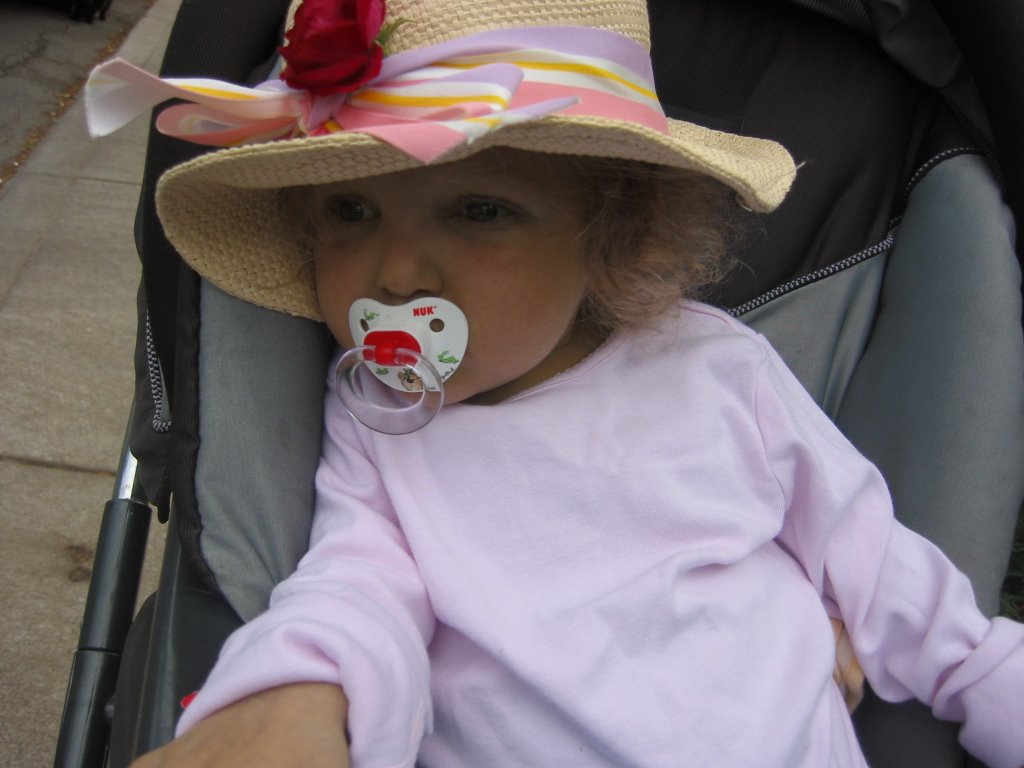
Sasha, 27 hours before she flew away. We went for several walks a day often stopping at the neighbour's large wild rose bush to take a flower for her hat.

Return of the clots


When we got back from the walk her bag was leaking so we out her in the bath and replaced it, she was not charmed at all. But she managed a few smiles. Pam's brother Kenny dropped by and we walked some nice alleys off Wychwood, so peaceful they are. We bumped into Michelle and Pierre and their two gals. Mimi talked to her sweetly for some time but she stared ahead, in her own little world. Mimi is about 7 and old beyond her years. Will she see her sister, she asked me. I don't know sweetie, we'll see, was all I could muster.

After her bath we went out again a bit later on and she managed a happy grunt when she saw the stroller. This time she lay most of the time, the wind picking up her golden freshly cleaned curls. She looked like an angel asleep. Marcia dropped by and walked out to carry on the stroll however her bag was leaking again so we took her in. The clots keep getting bigger and pushing off the bag. So we replaced it in the bath after her first walk and had to replace it again at 7pm and then patch it again an hour later. Henry dropped by. Reina came over and we made some barbecued salami, steak, sausages and had it with a Greek cucumber salad and roasted fries. All she was interested in was a few bits of a freezie.

She is getting crankier as her lips get bluer and so Dr Goldman suggested we try Tylenol suppositories before dipping into the morphine. We just put her to sleep to Grisman and Garcia's bluegrassy and twangy Not Just for Kids : Freight train, freight train run so fast, Freight train, freight train run so fast, Please dont tell them what train I'm on, They wont know what route I'm gone... Lets hope she sleeps.

Goodbye to Sick Kids 4D

I took a last walk to get coffee, camcorder running, thinking I would forget the animal painted hallways.

The day flew by. Trips to the car with the stroller, carrying out the animals and books and drawing boards and talking toys.

Choking up as we eventually walked past the nurses station where doctors and nurses milled to send us off.

Starting to feel the moment in the underground parking as we reached the car and looked at Sasha and ourselves and Sasha smiled.

Walking up the steps, watching her little face focusing intently. Still processing. And then a slow walk through the house, first the den where she had played, Sam twisting and turning and barking happily, then the kitchen where we pushed the buttons of a banjo playing fridge toy and watched her evolving intensity. Did she remember?

Then up to her room, to see the crib she had refused to sleep in, the books, the lovely flower light on the wall, the row of teddies and stuffed animals piled 3 foot high and 4 foot wide.

And then on the bed we had slept in before Sick kids we laid her to rest and she started to speak, a little bubble that grew, new sounds of happiness. And she slept soundly.

The nurses came at 3 and again at dinner time to orient us and themselves. The pump was new so the night nurses took a couple hours to deconstruct and reconstruct the TPN proceedures, patiently, with humour. Everything with CCAC was about what we happened, what would make us happier, more mobile. Such a relief.

Home sweet home.

Today is the day

After five long months at SickKids Hospital in Toronto we are taking Sasha home. Not as we expected and hoped, to continue our lives happily together, but to let Sasha go to sleep in her home, in our bed, surrounded by our love, at the time of her tired body's choosing, in as much comfort as we can provide.

This blog will give us a chance to celebrate her life and record her days at home.

Sasha has a severe form of Alagille Syndrome, born without a pulmonary artery and a very compromised liver that resulted in an early and severe case of portal hyptension.

Despite Sick Kids telling us there was great risk in surgery, her first shunt was a great success and we returned home within two weeks. She developed the severe itchiness that is a mark of Alagille along with an infectious laugh, a love of people and that wonderful baby curiosity. Just as she was starting to walk, we prepared for a second cardiac surgery.

We were bumped a number of times. And the foreboding and fear grew.

Her second surgery on December 14 began like the first, with internal bleeding. However this time the bleeding did not stop after the cardiac surgeon went back in. With the loss of blood to her lower organs, her liver went into failure. After her liver numbers stabilized she started to poo and vomit blood. When surgeons cut her open to see the site of the bleeding, she bled so much they quickly stiched her up. A fistula resulting from opening up her belly and she has been venting tummy fluid and blood for more than 3 months.

After 5 months of hope that some proceedure would right the balance in her little body after her second cardiac surgery, we decided not to go ahead with a TIPPS proceedure that might have stopped her GI bleeds by alleviating the portal hypertension that has developed in hospital (or possibly was lurking before).

When we looked at where she is now, and how far she has come back since the weeks following the surgery, we felt: enough.

We didnt want to put her through another 2-3 proceedures to give her maybe 1 or two more year of life, or not, with a high chance of death on the table, or coma, or confusion where she didnt recognise us for weeks.

Now she knows she is loved, she is not in pain and heartbreakingly she still has smiles and laughter for those around her.

When you enter the world of paliative care, you are experiencing life and death at the same time. We are all living and dying. With Sasha we are trying to live life to the fullest possible even as we know that she likely has only 3-4 days before she will prefer to sleep over waking.